
07
Oct
AI Procurement Automation in Saudi Arabia | Aramco Case Study
In engineering procurement, having access to information is not enough.
The real competitive advantage comes from how quickly an organization can extract, analyze, prioritize, and act on procurement intelligence.
For engineering contractors, EPC companies, equipment suppliers, and industrial procurement organizations in Saudi Arabia, large technical reports can contain valuable bidding opportunities. However, manually reviewing hundreds or even thousands of pages creates delays that can directly affect procurement efficiency and tender response times.
This was the challenge facing a leading engineering firm in Saudi Arabia.
The company relied on daily Aramco morning reports to identify equipment requirements and procurement opportunities. Individual reports could contain approximately 900–1,000 pages covering technical specifications, quantities, locations, deadlines, and other critical procurement information.
Manual analysis required approximately 7–8 days of engineering and procurement effort for each report.
The solution was an AI-powered data analytics and intelligent document processing platform designed around the firm's actual procurement workflow.
The result?
Report analysis time dropped from 7–8 days to approximately 33 minutes.
And that was only the beginning.
The Challenge of Manual Engineering Procurement Analysis
Large engineering and procurement organizations generate and process enormous volumes of information.
Tender documents, RFQs, RFPs, technical specifications, procurement reports, equipment requirements, supplier documents, and project data can all contain information that directly affects commercial opportunities.
The problem arises when that information remains trapped inside unstructured documents.
In this case, the engineering firm's procurement specialists had to manually review large Aramco morning reports to identify relevant opportunities.
This created several operational challenges.
Slow Report Processing
Engineers and procurement specialists could spend 7–8 days manually reviewing a single report.
That meant significant engineering resources were being used for document reading rather than higher-value activities.
Risk of Data Extraction Errors
When hundreds of pages are reviewed manually, important information can be overlooked.
Critical specifications, quantities, procurement requirements, equipment information, and deadlines could potentially be missed during manual extraction.
Delayed Tender Responses
Every additional day spent identifying an opportunity reduces the time available for:
Technical evaluation
Supplier coordination
Pricing
Commercial analysis
Bid preparation
Tender submission
For competitive procurement environments, speed matters.
Limited Bidding Capacity
Manual processing also created a scalability problem.
If teams could only analyze a limited number of reports, the organization could only evaluate a limited number of procurement opportunities.
The challenge therefore wasn't simply:
“How can we read these reports faster?”
It was:
“How can we convert large engineering reports into structured procurement intelligence?”
The Solution: AI-Powered Data Analytics for Engineering Procurement
A custom AI-powered data scraping and analytics platform was developed around the company's procurement process.
Instead of manually moving through hundreds of pages, the system automated the workflow:
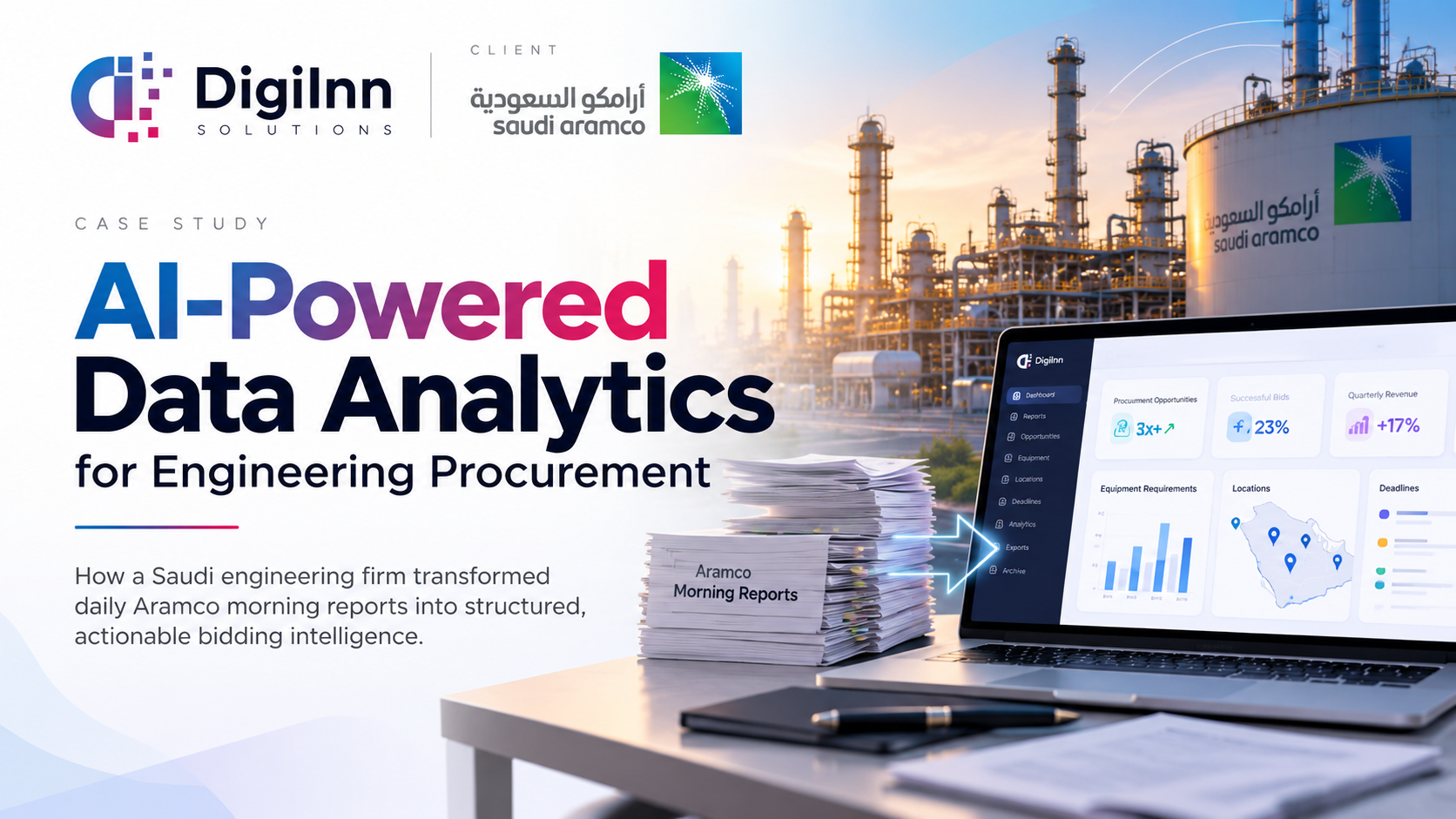
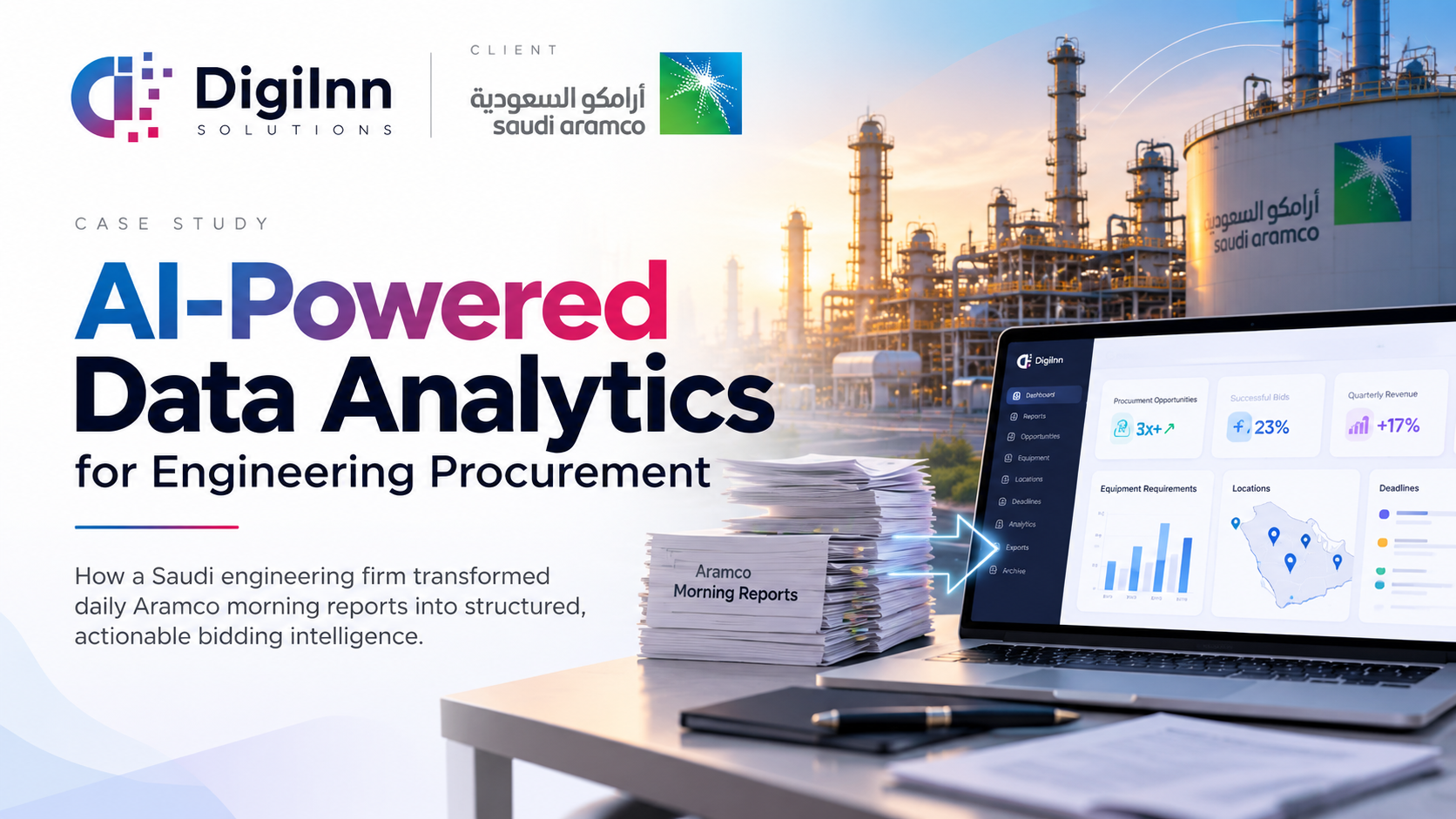
Aramco Morning Report → AI Processing → Data Extraction → Opportunity Identification → Procurement Analytics → Bid Preparation
The goal was not merely to digitize documents.
The goal was to make the information inside those documents searchable, structured, prioritized, and actionable.
1. AI-Powered Report Analysis
The platform automatically processed large PDF-based Aramco morning reports and identified relevant engineering and procurement information.
Instead of requiring teams to manually inspect every page, AI document processing helped identify information relevant to the company's bidding activities.
This significantly reduced repetitive report-reading work.
2. Automated Data Scraping
One of the core components of the solution was automated data scraping.
The system extracted structured information from complex technical reports without requiring page-by-page manual review.
For organizations dealing with large engineering datasets, automated data extraction can help transform unstructured documents into usable business information.
3. Intelligent Procurement Opportunity Identification
Extracting data alone does not create procurement intelligence.
The system therefore incorporated predefined business rules to identify relevant equipment requirements and procurement opportunities.
This allowed teams to focus on opportunities that were more relevant to their operations instead of manually filtering every piece of extracted information.
4. Technical Data Extraction
The AI-powered system identified important procurement fields, including:
Equipment specifications
Quantities
Locations
Procurement requirements
Deadlines
Technical information
Relevant bidding opportunities
The extracted information could then be structured for further analysis and decision-making.
5. Procurement Analytics Dashboard
Extracted information was presented through a centralized procurement analytics dashboard.
Instead of searching through hundreds of pages, teams could review structured procurement intelligence from one interface.
The dashboard supported activities such as:
Reviewing procurement opportunities
Categorizing requirements
Prioritizing urgent items
Tracking deadlines
Exporting bid-ready information
This helped shift the workflow from document reading toward data-driven procurement decision-making.
6. Automated Bid Data Export
Once relevant opportunities were identified, structured summaries could be generated for bidding workflows.
Excel-ready exports reduced the manual effort required to transfer information from technical reports into procurement and bid-preparation processes.
This created a more efficient connection between opportunity identification and tender preparation.
Building AI Around the Actual Engineering Workflow
Successful AI implementation is not simply about applying a generic model to documents.
The system must understand the context in which the information will be used.
Before development, more than 50 representative Aramco morning reports were analyzed.
This helped establish an understanding of:
Report structures
Engineering terminology
Equipment requirements
Relevant keywords
Extraction patterns
Procurement workflows
Required data fields
Business rules
Performance benchmarks
Industry-specific keywords, equipment terminology, codes, and extraction patterns were then incorporated into the platform.
During a one-month live test before full rollout, the platform achieved 92% validation accuracy.
From Manual Report Reading to Procurement Intelligence
The transformation can be summarized simply.
Traditional Procurement Workflow
Large Aramco Reports
↓
Manual Reading
↓
Manual Data Extraction
↓
Opportunity Identification
↓
Engineering Review
↓
Bid Preparation
↓
Tender Submission
AI-Powered Procurement Workflow
Large Aramco Reports
↓
Automated Processing
↓
AI-Powered Data Extraction
↓
Procurement Intelligence
↓
Opportunity Prioritization
↓
Bid-Ready Data
↓
Faster Tender Submission
The difference is not simply automation.
It is the ability to move from unstructured technical information to actionable procurement intelligence.
Measurable Business Impact
The implementation produced measurable operational and commercial results.
7–8 Days → 33 Minutes
The most significant improvement was report analysis time.
A process that previously required approximately 7–8 days could be completed in around 33 minutes.
3x+ Bidding Opportunities
Faster analysis increased the number of opportunities the organization could evaluate and pursue.
+23% Successful Bids
Greater visibility into procurement opportunities and faster processing contributed to an increase in successful bids.
+17% Quarterly Revenue
The case study recorded a 17% increase in quarterly revenue following implementation.
These outcomes demonstrate an important principle:
AI automation creates the greatest value when it improves a business-critical workflow rather than simply automating an isolated task.
Higher Engineering Productivity
Automation also changed how engineering resources could be allocated.
Instead of spending significant time manually reading reports, teams could focus on activities requiring human expertise, including:
Supplier negotiations
Technical evaluation
Bid strategy
Commercial analysis
Customer engagement
Procurement planning
AI handled repetitive information processing while engineering and procurement professionals focused on decisions.
Building a Historical Procurement Intelligence Database
Another important component of the platform was the creation of a historical procurement database.
Extracted information could be archived for:
Procurement trend analysis
Supplier research
Opportunity tracking
Historical reference
Audit trails
Over time, this creates more than an automated document-processing system.
It creates a growing source of procurement intelligence.
Historical data can help organizations understand recurring requirements, identify patterns, study procurement activity, and improve future decision-making.
AI in Saudi Arabia's Engineering and Procurement Sector
As engineering, industrial, and infrastructure organizations across Saudi Arabia continue to digitize their operations, the ability to process large volumes of technical information is becoming increasingly important.
For EPC companies, engineering contractors, equipment suppliers, and industrial procurement organizations, AI can support workflows where teams routinely process complex technical documentation.
Potential applications extend far beyond Aramco morning reports.
The same AI-powered approach can support:
Tender Management
Automatically organize and analyze tender documents to help teams identify requirements and deadlines.
RFQ Analysis
Extract structured information from requests for quotation and make relevant data easier to evaluate.
RFP Processing
Use intelligent document processing to analyze complex requests for proposals.
Procurement Automation
Automate repetitive information extraction, categorization, and opportunity-identification workflows.
Equipment Demand Forecasting
Use historical procurement information to support analysis of equipment demand patterns.
Supplier Intelligence
Build searchable historical information that can support supplier research and procurement planning.
Bid Opportunity Management
Centralize relevant opportunities and make them easier to prioritize and track.
Engineering Document Automation
Transform large technical documents into structured information that teams can search, analyze, and use.
AI Data Analytics Is More Than Automation
There is an important distinction between digitization, automation, and intelligence.
Digitization turns paper-based information into digital information.
Automation reduces repetitive manual tasks.
Intelligence helps organizations understand what information matters and what action should follow.
For engineering procurement, that progression can look like this:
Documents → Structured Data → Analytics → Intelligence → Decision → Action
This is where AI can create measurable business value.
Why Procurement Intelligence Matters for EPC and Engineering Companies
Engineering organizations compete on more than technical capability.
They also compete on speed, information, execution, and decision-making.
A valuable opportunity identified too late may no longer be valuable.
A tender discovered early gives teams more time for technical evaluation, supplier coordination, commercial analysis, pricing, and bid preparation.
That makes information-processing speed an operational advantage.
For companies managing hundreds or thousands of pages of procurement documentation, AI-powered engineering procurement solutions can help reduce the distance between information and action.
The Future of AI-Powered Procurement
The future of procurement is not about replacing engineering or procurement professionals with AI.
It is about removing repetitive information-processing work so professionals can spend more time on the activities where their expertise creates the most value.
AI can process.
AI can extract.
AI can categorize.
AI can help prioritize.
But engineers, procurement specialists, and commercial teams remain responsible for evaluating opportunities, building supplier relationships, developing bidding strategies, negotiating, and making business decisions.
The strongest model is therefore not:
AI instead of people.
It is:
AI-powered workflows that help people make faster, better-informed decisions.
From Aramco Morning Reports to Actionable Procurement Intelligence
For engineering contractors, equipment suppliers, EPC companies, and industrial procurement organizations in Saudi Arabia, access to information is only one part of the challenge.
The competitive advantage comes from how quickly that information can be transformed into action.
In this case, AI-powered data analytics transformed large Aramco morning reports from a time-consuming manual process into structured procurement intelligence.
The impact included:
7–8 days to 33 minutes in report analysis time.
3x+ bidding opportunities.
23% increase in successful bids.
17% increase in quarterly revenue.
The lesson is straightforward:
The goal isn't to process more documents.
The goal is to identify more opportunities, faster.
Build an AI-Powered Engineering & Procurement Solution
Organizations dealing with technical reports, tenders, RFQs, RFPs, procurement documents, and engineering data can use customized AI-powered solutions to transform unstructured information into actionable intelligence.
From AI document processing and automated data extraction to procurement analytics, tender automation, and bid opportunity management, intelligent systems can help organizations reduce manual effort and accelerate decision-making.
If your engineering or procurement teams are still spending days manually reviewing technical documents, it may be time to turn those documents into intelligence.
Leave A Comments