

26Feb
How Can You Build a High-Performance API with GraphQL and REST Together?
APIs play a very important role in advanced application development that allow smooth communication between different services. REST has been standard for years and GraphQL provides a more flexible and efficient way to question data. But have you ever thought about what if we combine both to build high performance and strong API?
Key Differences Between GraphQL and REST
Before combining GraphQL and REST for APIs it is important to know the key differences between them
Combining GraphQL and REST for APIs
Combining the GraphQL and REST for APIs include several steps and considerations. We will discuss them below one by one.
Optimizing Performance in a Hybrid GraphQL-REST API
Caching Strategies for REST and GraphQL
Caching can significantly improve performance and decrease server load.
REST APIs can combine CDNs and HTTP caching (e.g ETags, Cache-Control headers) to store and serve usual requested data.
GraphQL needs response caching and query complexity analysis to avoid excessive computational overhead.
Implement persistent query storage to cache usually used GraphQL queries for faster execution.
Query Optimization in GraphQL
Optimize GraphQL queries and ensure efficient data retrieval.
Use Query Batching to reduce the amount of network requests. This step greatly helps in decreasing the latency.
Apply pagination for avoiding poor performance.
Use persisted queries to avoid unwanted request parsing and improve response times.
Optimize GraphQL resolvers to reduce database calls and improve execution efficiency.
Load Balancing and Rate Limiting
If the API is designed with a combination of GraphQL and REST then it requires effective load management.
Position API Gateways to distribute traffic evenly across several servers and avoid bottlenecks.
Apply rate limiting to prevent excessive requests from single users or applications.
Observe API performance metrics using observability tools such as Prometheus and Grafana to monitor and improve API response time.
Decreasing Over-Fetching and Under-Fetching
Over-fetching and under-fetching can result in performance degradation.
The end points of REST should return only important fields by designing resource specific endpoints.
GraphQL enables selective data fetching, improving network usage by allowing clients to request only the wanted fields.
Apply data loaders to batch requests efficiently and avoid redundant database queries.
Security Consideration for GraphQL and REST Integration
Authentication and Authorization
Make sure that you have safe and secure access to API by implementing
OAuth 2.0 or JWTs for user authentication and session management.
Role based access control to avoid access based on users role.
API Keys and token based authentication to secure endpoints and avoid unauthorized access.
Handle Rate Limiting and Choking
It is very important to protect the APIs from abuses with the help of following
Rate Limiting for avoiding the number of API requests per user or application.
GraphQL Query Cost Analysis to restrict expensive questions from overloading the server.
Token based rate limiting ensures fair usage among the users.
Avoid the Overly Complex GraphQL Queries
GraphQL enables deep nested queries, but they can cause problems.
Apply query depth limiting to avoid overly complex requests that can affect the server performance.
Use queries cost analysis to assign a cost to each query type and reject expensive queries.
Observe query execution times to detect and reduce slow queries before they can result in problems.
API Gateway Security Best Practices
API Gateways greatly help in securing both REST and GraphQL
Use Web Application Firewalls (WAF) to restrict suspicious users and protect against attacks.
Implement logging and monitoring to identify malicious API patterns.
Apply CORS Policies to avoid unauthorized cross-origin requests and protect data integrity.
Managing Data Fetching Efficiently with GraphQL and REST
When to use REST for Huge Data
REST is usually better for huge data transfer because of its simplicity and efficiency
REST endpoints have the ability to provide paginated responses efficiently with standard HTTP Caching.
GraphQL’s flexibility can be inefficient for huge datasets if not properly optimized.
How GraphQL Improves Data Fetching?
GraphQL provide various benefit in fetching data
Decrease several round trips by aggregating queries and fetching related data in a single request.
Allows clients to request only needed fields, reducing payloads sizes and improving performance.
Handling Nested Queries in GraphQL
Nested queries also help improving efficiency but it needs very attentive management.
Use Dataloader to batch and cache queries efficiently, decreasing redundant database hits.
Improve resolver functions to decrease processing time and reduce computational overhead.
API Gateway Approaches for Efficient Fetching
An API Gateway can bridge GraphQL and REST effectively
Act as a unified endpoint for both REST and GraphQL simplifying API Management.
Handle query routing and response transformation dynamically to improve performance.
Conclusion
Combining the GraphQL and REST in a high performance API needs careful design, improvement and security measures. By combining the strengths of both, you can create a scalable, efficient and secure API to your application.

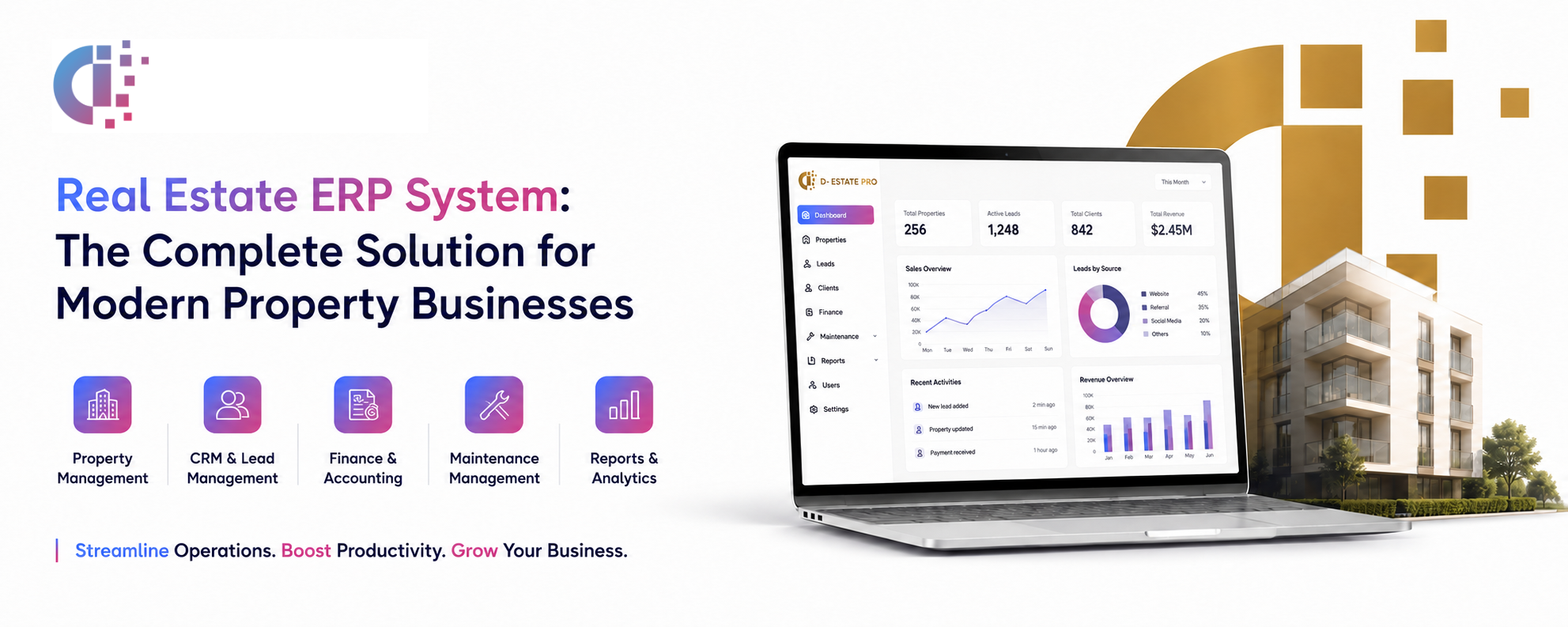
Real Estate ERP System: The Complete Solution for Modern Property Businesses
June 23, 2026, 7:14 a.m.



Leave A Comments