
27
Oct
Transforming Restaurant Operations Through Smart ERP & POS Technology
Running a successful restaurant requires more than great food and excellent customer service. Behind every order is a complex network of operations, from billing and kitchen coordination to inventory management, delivery tracking, and financial reporting.
As restaurant businesses expand, managing these activities through disconnected systems can become increasingly difficult.
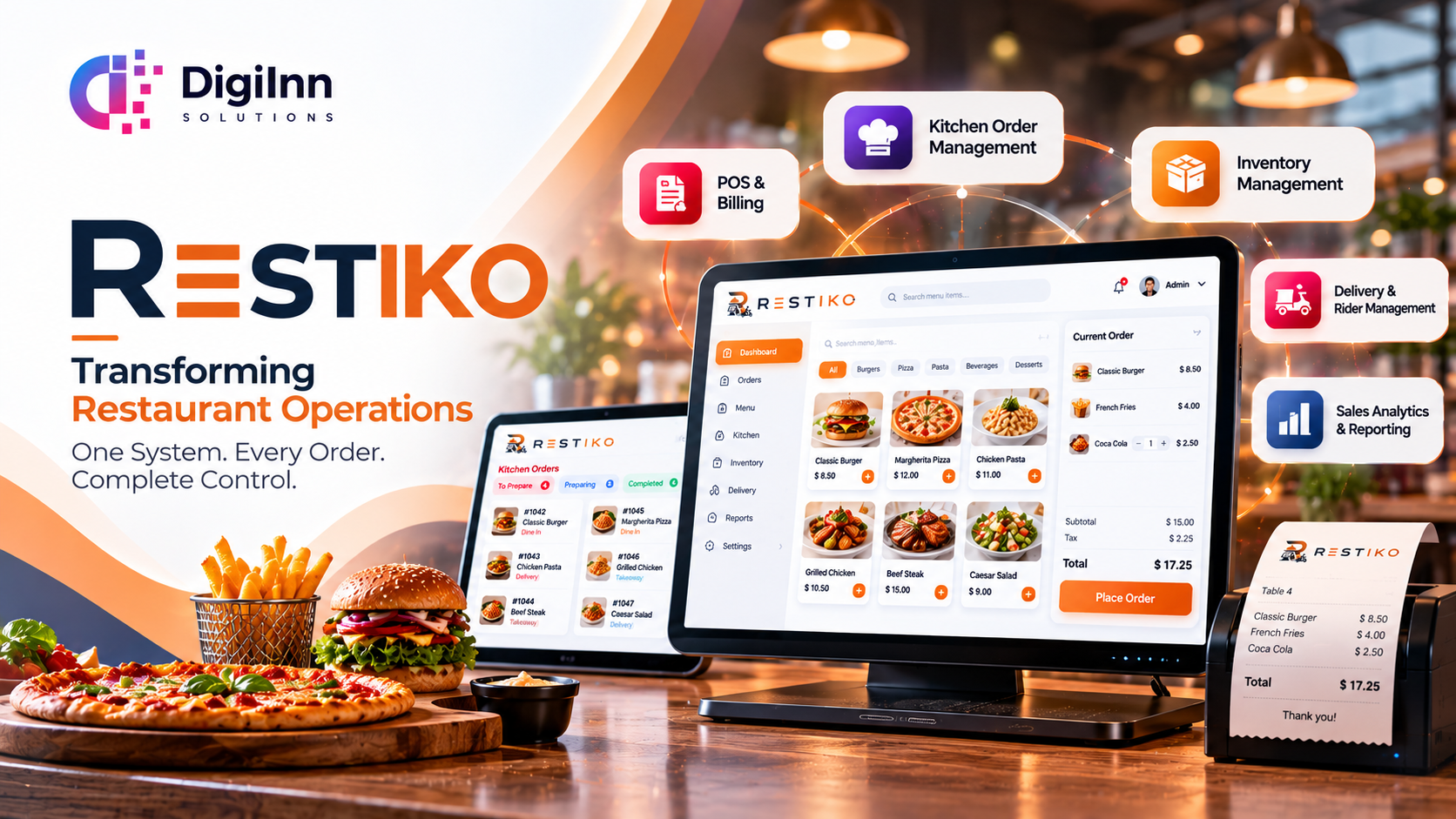
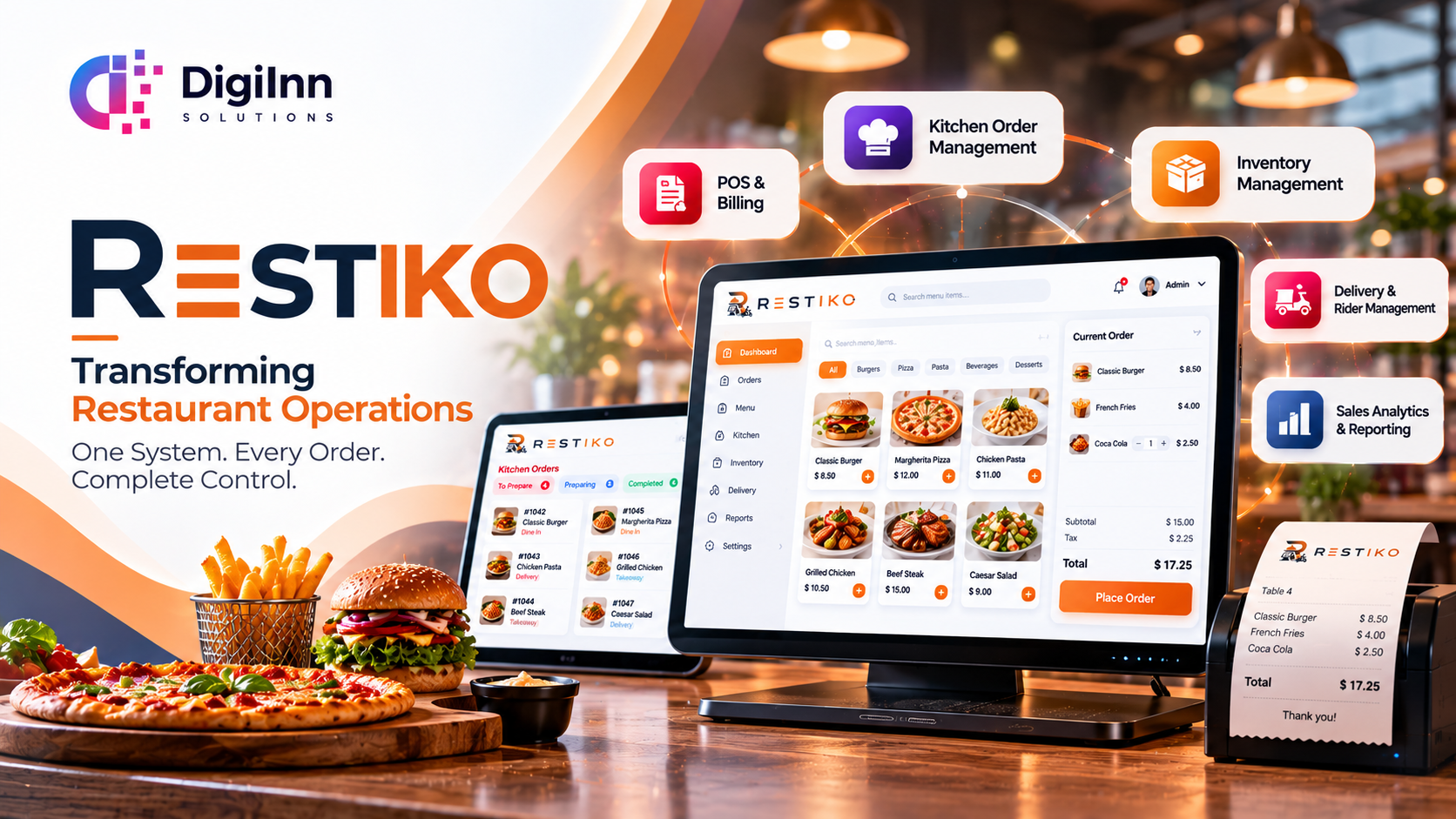
Recognizing these operational challenges, Digi-Inn Solutions developed Restiko, a restaurant management solution designed to connect essential restaurant workflows within one digital ecosystem.
Restiko combines restaurant ERP capabilities with point-of-sale functionality to help businesses organize daily operations, improve coordination, and gain better visibility into performance.
The Challenge: Managing Multiple Restaurant Operations
Restaurant operators often face challenges that become more difficult as order volumes and business complexity increase.
1. Disconnected Order Management
When orders are recorded manually or managed through separate channels, communication between service staff and kitchen teams can become inconsistent.
2. Billing and Transaction Complexity
Managing dine-in, takeaway, and delivery transactions through disconnected processes can create additional administrative work.
3. Limited Inventory Visibility
Without an organized inventory system, restaurant managers may struggle to monitor stock usage, purchases, and replenishment requirements.
4. Kitchen Coordination
During busy service hours, kitchen teams need clear visibility into incoming orders, preparation priorities, and order statuses.
5. Lack of Centralized Reporting
When sales and operational information is scattered across different systems, management may find it difficult to assess business activity efficiently.
The central challenge: How can restaurants connect their essential operations through one structured management system?
The Solution: Restiko Restaurant ERP & POS
Restiko was designed to address these challenges through an integrated restaurant management platform.
Instead of relying on multiple disconnected tools, restaurant businesses can use a centralized system to coordinate their core operations.
1. Smart Point-of-Sale Management
Restiko supports organized billing and transaction management, helping restaurant staff process orders through a structured POS workflow.
Operational value: More consistent order handling and improved transaction organization.
2. Kitchen Order Management
With kitchen order ticket functionality, order information can move from the ordering process to kitchen operations.
This helps teams manage preparation workflows and coordinate incoming requests.
Operational value: Clearer communication between ordering and kitchen teams.
3. Inventory and Purchase Management
Restaurant operations depend on maintaining visibility into available ingredients, supplies, and purchasing activities.
Restiko's inventory and purchase management capabilities support more organized stock records and replenishment processes.
Operational value: Better inventory visibility and purchasing coordination.
4. Delivery and Rider Management
For restaurants offering delivery services, coordinating order assignments and delivery activities is an important operational requirement.
Restiko includes rider-related functionality to support delivery operations.
Operational value: More structured delivery coordination.
5. Sales Analytics and Reporting
Restaurant owners need access to relevant business information to understand sales activity and operational performance.
Restiko provides reporting capabilities that help management review restaurant activity through a connected system.
Operational value: Improved visibility into sales and daily operations.
How Restiko Connects Restaurant Operations
Restiko's value comes from connecting different stages of the restaurant workflow.
Step 1 Order Received
A customer places an order, which is entered into the restaurant's ordering system.
Step 2 Order Processing
The system organizes the order and supports the relevant billing workflow.
Step 3 Kitchen Coordination
Order details are communicated through the kitchen order management process.
Step 4 Delivery or Order Completion
The restaurant coordinates the appropriate fulfillment process, including delivery operations where applicable.
Step 5 Management Reporting
Relevant sales and operational records become available for management review.
By connecting these stages, Restiko supports a more structured restaurant operating environment.
Business Value: What Restiko Is Designed to Improve
| Restaurant challenge | Restiko capability | Intended business benefit |
|---|---|---|
| Disconnected billing | Integrated POS | Organized transaction management |
| Manual kitchen coordination | Kitchen order tickets | Clearer order communication |
| Scattered stock records | Inventory management | Better stock visibility |
| Unstructured purchasing | Purchase management | Improved procurement organization |
| Delivery coordination | Rider management | More connected delivery workflows |
| Limited reporting | Sales and analytics | Better operational oversight |
These are intended operational benefits of the platform, not measured outcomes from a named customer deployment.
Who Can Benefit From Restiko?
Restiko is relevant to restaurant businesses seeking more structured digital operations, including:
Dine-in restaurants
Fast-food outlets
Cafés and coffee shops
Takeaway businesses
Delivery-focused restaurants
Growing restaurant groups
The appropriate configuration and implementation scope depend on each restaurant's operational requirements.
The Role of Digital Transformation in Restaurant Management
Restaurant digital transformation is not simply about replacing paper bills with a computerized system.
It involves connecting the activities that keep a restaurant functioning.
When billing, kitchen workflows, inventory, delivery coordination, and reporting are managed through compatible systems, businesses can reduce unnecessary fragmentation.
This creates a stronger foundation for operational consistency and future expansion.
Why Digi-Inn Solutions Developed Restiko
At Digi-Inn Solutions, our approach to custom software development focuses on solving practical business problems.
Restiko reflects this approach by bringing essential restaurant management functions together within a connected platform.
The objective is to help restaurant operators move away from fragmented processes and toward more organized, technology-supported operations.
Conclusion: Smarter Restaurant Operations Start With Connected Systems
Restaurant businesses need reliable operational processes to support consistent service.
From order processing and kitchen coordination to inventory management and reporting, each activity contributes to the overall customer experience.
Restiko by Digi-Inn Solutions is designed to connect these activities through an integrated restaurant ERP and POS platform.
One Restaurant. One Connected System. Smarter Operations.

Leave A Comments