

20Aug
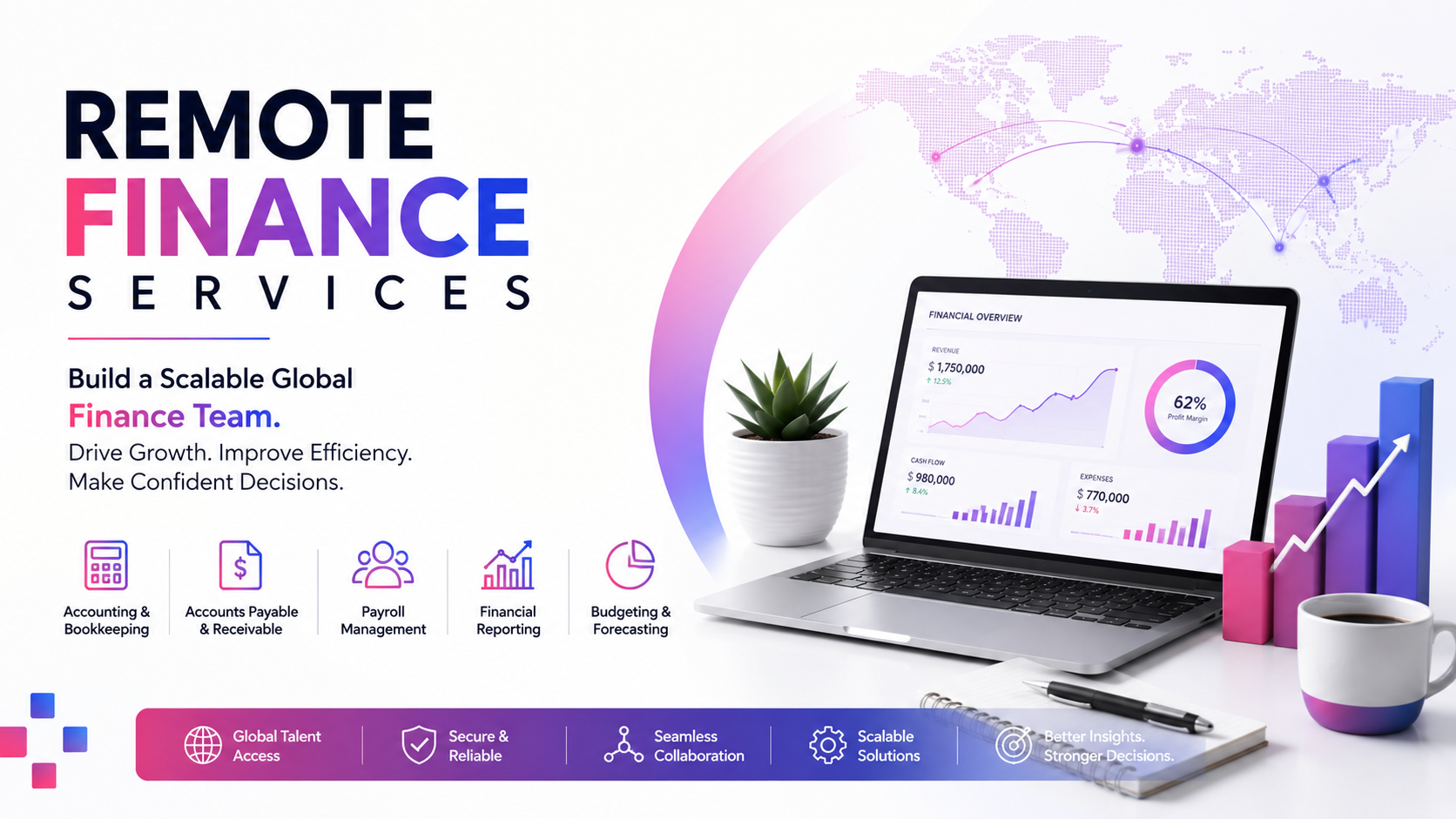
Remote Finance Services Globally: Build a Smarter, Scalable Finance Team
For modern businesses, finance is no longer simply about recording transactions and preparing reports. Finance teams are expected to provide accurate information, maintain financial controls, support forecasting, improve cash flow visibility, and help leadership make better decisions.
At the same time, businesses operating across countries and time zones face increasing pressure to find skilled finance professionals, manage growing transaction volumes, and maintain efficient processes.
This is where Remote Finance Services are becoming a strategic solution.
Instead of building a large in-house finance department, businesses can work with dedicated remote finance professionals who support accounting, bookkeeping, payroll, reporting, budgeting, and other financial operations from anywhere in the world.
The global finance and accounting outsourcing market is continuing to expand. Grand View Research estimates the market at approximately $76.5 billion in 2026, with a projected CAGR of 9.3% through 2033. Current industry research also shows that finance outsourcing is moving beyond basic cost reduction toward technology-enabled operations, automation, analytics, and strategic finance support.
What Are Remote Finance Services?
Remote Finance Services allow organizations to access professional finance and accounting expertise without maintaining every role internally.
A remote finance team can operate as an extension of an existing finance department or function as an outsourced finance department for businesses that need additional capacity.
Depending on business requirements, remote finance support can include:
· Bookkeeping and accounting
· Accounts payable and receivable
· Payroll management
· Financial reporting
· Budget planning
· Cash-flow monitoring
· Account reconciliation
· Invoice processing
· Financial data management
· Management reporting
· Finance administration
The objective is not simply to move finance tasks outside the office. A well-designed remote finance model should improve accuracy, visibility, scalability, and operational efficiency.
DigiInn Solutions provides remote finance professionals to support bookkeeping, payroll, reporting, budgeting, accounts payable and receivable, and tax documentation.
Why Global Businesses Are Choosing Remote Finance Teams
Businesses around the world are reconsidering how finance functions should be structured.
Talent shortages, rising employment costs, increasing transaction volumes, and the need for specialized skills are encouraging organizations to explore outsourced and remote finance models.
Research published in 2026 indicates that finance leaders are increasingly looking to external providers not only for efficiency but also to address capability and execution gaps. Hybrid delivery models are also becoming more common as companies balance scalability, collaboration, expertise, and control.
1. Access to Global Finance Talent
A traditional hiring model limits businesses to professionals available within a specific geographic area.
Remote finance services remove that limitation.
Organizations can access professionals with experience in accounting, reporting, bookkeeping, payroll, financial analysis, and other finance functions regardless of where they are located.
For growing companies, this creates a much larger talent pool.
2. Scalable Finance Operations
Finance requirements change as businesses grow.
A startup may initially require bookkeeping and invoice management. As it expands, it may need payroll, financial reporting, budgeting, accounts receivable, accounts payable, and management reporting.
A remote finance team can scale alongside those requirements.
Instead of rebuilding the finance department every time the business grows, organizations can add specialized support when needed.
3. Better Operational Efficiency
Finance teams often spend significant time on repetitive processes such as reconciliations, invoice processing, data entry, payroll administration, and reporting.
Outsourcing these processes to specialized professionals can help internal leadership and finance teams dedicate more time to analysis and strategic decision-making.
The finance outsourcing industry is increasingly combining human expertise with automation and digital platforms to improve efficiency and reporting.
4. Reduced Fixed Overhead
Building a large internal finance department can involve recruitment, salaries, benefits, infrastructure, software, training, and ongoing management.
Remote finance outsourcing can provide access to specialized professionals without requiring every role to become a permanent internal position.
For businesses experiencing rapid growth, this creates a more flexible operating model.
What Does a Remote Finance Team Do?
A remote finance team can support different stages of the financial workflow.
Bookkeeping & Accounting
Accurate bookkeeping provides the foundation for financial visibility.
Remote accounting professionals can help maintain financial records, organize transactions, reconcile accounts, and keep financial information up to date.
Accounts Payable & Receivable
Managing money coming into and leaving a business is essential for maintaining healthy cash flow.
Remote finance professionals can support:
· Invoice processing
· Payment tracking
· Receivables monitoring
· Vendor records
· Customer balances
· Payment follow-ups
Payroll Management
Payroll can become increasingly complex as businesses expand across teams, locations, and employment structures.
Remote finance professionals can assist with payroll administration, record management, calculations, and reporting in accordance with the processes established by the business.
Financial Reporting
Leadership teams need accurate financial information to understand business performance.
Remote finance teams can support recurring reports covering revenue, expenses, cash flow, receivables, payables, and other business metrics.
Better reporting gives decision-makers greater visibility into where the business stands.
Budgeting & Forecasting
Finance should not only explain what happened it should help businesses prepare for what comes next.
Remote finance professionals can support budgeting, forecasting, expense planning, and financial analysis to help leadership make informed decisions.
Remote Finance Services vs. Traditional In-House Finance Teams
Remote finance services do not necessarily mean replacing the entire internal finance department.
For many organizations, the most effective model is a hybrid finance team.
An internal team can retain responsibility for leadership, approvals, financial strategy, and sensitive decision-making, while remote professionals handle operational and specialized finance functions.
This approach provides businesses with a combination of:
Internal leadership + remote expertise + technology + scalable execution
Current outsourcing models are increasingly moving toward hybrid delivery rather than treating outsourcing as a simple transfer of repetitive tasks.
The Role of Technology in Remote Finance
Remote finance operations depend heavily on digital systems.
Cloud accounting platforms, ERP systems, financial dashboards, automation, digital documentation, and secure communication tools allow finance professionals to collaborate across locations.
Artificial intelligence and automation are also changing finance operations.
Routine activities such as invoice processing, reconciliations, data handling, and reporting can increasingly be supported by automation, allowing finance professionals to spend more time on analysis and higher-value work.
However, technology should support financial professionals rather than replace financial accountability.
Strong processes still require appropriate review, controls, data protection, and human oversight.
Who Can Benefit From Remote Finance Services?
Remote finance services can support organizations at different stages of growth.
They can be particularly useful for:
· Startups
· Growing businesses
· SMEs
· E-commerce companies
· SaaS companies
· Real estate businesses
· Construction companies
· Professional services firms
· Manufacturing businesses
· International companies
· Multi-location organizations
· Enterprises requiring additional finance capacity
The right model depends on transaction volume, business complexity, regulatory requirements, internal capabilities, and growth plans.
How to Build an Effective Remote Finance Team
Successful remote finance outsourcing requires more than simply hiring an accountant.
Businesses should consider five important areas.
Define Responsibilities
Clearly determine which activities will remain internal and which will be handled by the remote team.
Establish Financial Controls
Create clear approval processes, access permissions, documentation standards, and review procedures.
Use the Right Technology
Connect the remote team to the accounting, ERP, payroll, reporting, and communication platforms used by the organization.
Establish Reporting Standards
Define what reports are required, how frequently they should be delivered, and who is responsible for reviewing them.
Measure Performance
Track relevant KPIs such as reporting accuracy, reconciliation completion, invoice processing time, outstanding receivables, and reporting turnaround.
A structured approach turns remote finance support into an integrated part of the business rather than a disconnected outsourced function.
Why Choose DigiInn Solutions for Remote Finance Services?
DigiInn Solutions provides dedicated remote professionals designed to integrate with business operations.
Its remote finance offering includes bookkeeping and accounting, payroll management, financial reporting, budget planning, accounts payable and receivable, and tax documentation support.
The broader DigiInn remote model is built around dedicated professionals, scalable support, secure workflows, real-time communication, and industry-specific expertise.
For businesses that already have internal finance leadership, remote professionals can provide additional capacity. For organizations without a large finance department, a dedicated remote team can provide operational support without requiring the business to build every function internally.
The Future of Global Finance Operations
The future of finance is increasingly digital, connected, and distributed.
Businesses are moving from traditional finance outsourcing toward models that combine people, technology, automation, analytics, and strategic support.
Current industry research points toward greater adoption of hybrid delivery models, technology-enabled outsourcing, real-time analytics, and AI-supported finance operations.
For global businesses, this creates an opportunity to build finance operations around capabilities rather than geography.
The question is no longer:
“Where should our finance team sit?”
It is:
“What finance capabilities does our business need, and how can we access them efficiently?”
Conclusion
Remote Finance Services are becoming a practical way for businesses to build flexible, scalable, and technology-enabled finance operations.
From bookkeeping and payroll to accounts payable, financial reporting, budgeting, and finance support, remote professionals can become an extension of an organization's existing team.
For growing and global businesses, the right remote finance model can provide access to specialized talent while improving operational flexibility and allowing leadership to focus on growth.
Build your finance team around expertise, not geography.
With DigiInn Solutions, businesses can access dedicated remote finance professionals designed to support their operations and scale alongside their growth.
Frequently Asked Questions
What are Remote Finance Services?
Remote Finance Services provide businesses with professional finance and accounting support through teams working remotely. Services can include bookkeeping, accounting, payroll, reporting, budgeting, and accounts payable and receivable.
Are remote finance teams suitable for global businesses?
Yes. Remote finance teams can support organizations operating across different locations and time zones. However, businesses should ensure that their finance processes account for applicable local accounting, tax, payroll, privacy, and regulatory requirements.
What is included in outsourced finance services?
Depending on the provider and business requirements, outsourced finance services can include bookkeeping, accounting, payroll, accounts payable, accounts receivable, reconciliations, financial reporting, budgeting, forecasting, and finance administration.
Is remote finance outsourcing only about reducing costs?
No. Modern finance outsourcing is increasingly focused on scalability, access to specialized talent, technology adoption, automation, reporting, and operational transformation, not simply cost reduction.
How do I choose a remote finance service provider?
Evaluate the provider's finance expertise, technology capabilities, security processes, communication model, scalability, reporting standards, experience with your industry, and ability to work within your organization's financial controls.


Beyond Digital: How AI and Automation Are Redefining Business Transformation
Aug. 28, 2026, 2:16 p.m.
Restaurant Inventory Management: How to Reduce Food Waste, Stock Loss & Improve Profitability
Aug. 20, 2026, 10:48 a.m.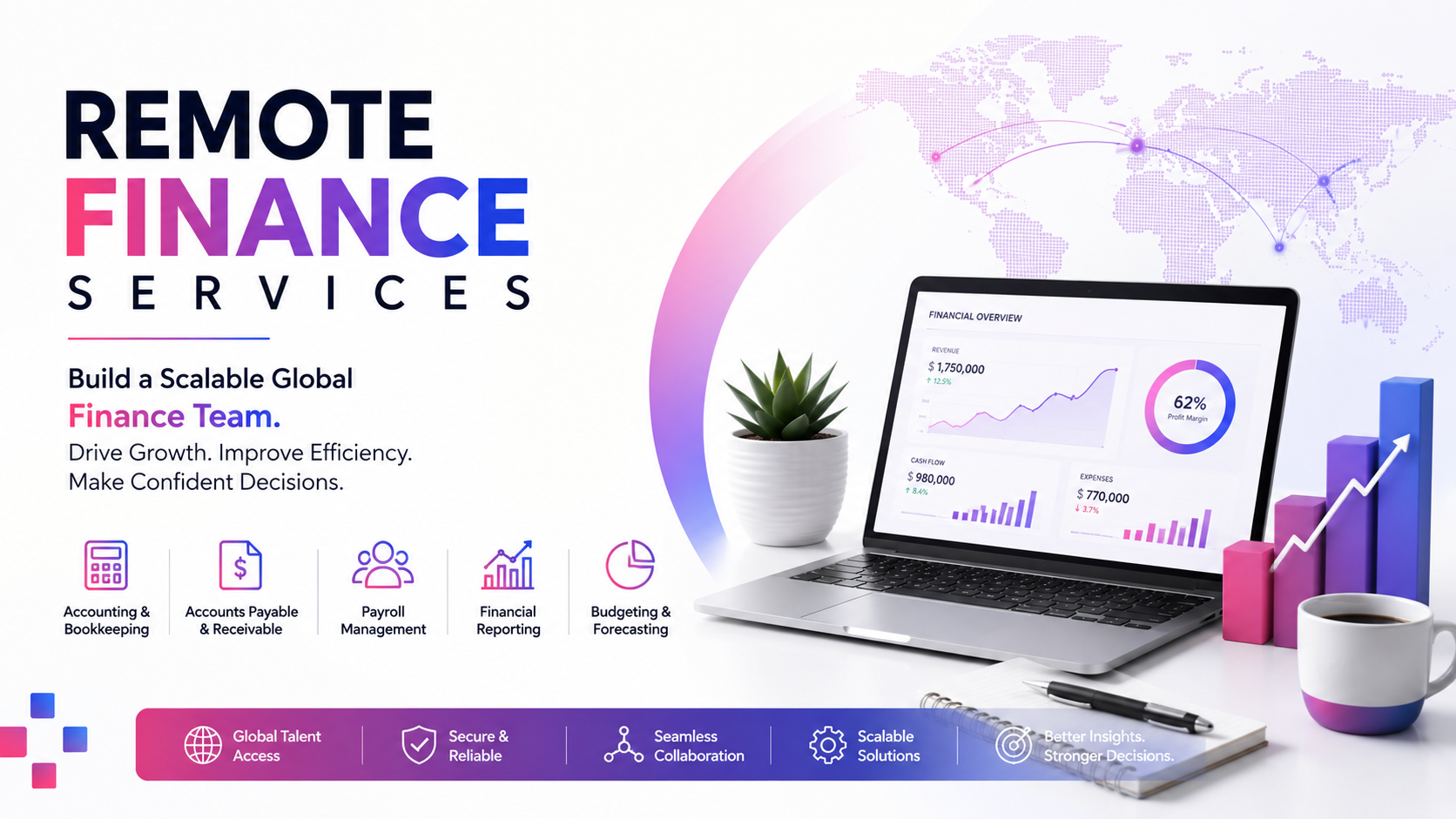




Leave A Comments