
19Oct
AI Agents for Business in 2026: How Intelligent Automation Is Transforming Business Operations
Imagine a business receiving customer inquiries through its website, WhatsApp, email, and social media.
The sales team manually enters those inquiries into a CRM. Employees assign leads, send follow-up messages, update spreadsheets, and prepare reports for management.
Each activity may appear simple.
But when these tasks happen repeatedly across multiple departments, they create an invisible operational burden.
Employees spend valuable time transferring information between systems rather than focusing on customers, business development, and strategic decisions.
This is one reason AI agents for business and intelligent workflow automation are becoming increasingly relevant in 2026.
Companies are moving beyond basic chatbots and isolated automation tools. They are exploring AI-powered systems that can coordinate tasks, interact with business applications, and support more complex workflows.
At Digi-Inn Solutions, we believe the future of business automation is not about replacing people with technology.
It is about connecting people, processes, and systems so businesses can operate more intelligently.
What Are AI Agents for Business?
An AI agent is a software-based system that can use artificial intelligence to interpret information, make decisions within defined boundaries, and carry out tasks toward a specific objective.
Unlike a traditional chatbot that primarily responds to questions, an AI agent may interact with connected applications, retrieve relevant information, and initiate permitted actions.
For example, a customer support chatbot may answer a question about a company's services.
A properly configured AI agent could go further by:
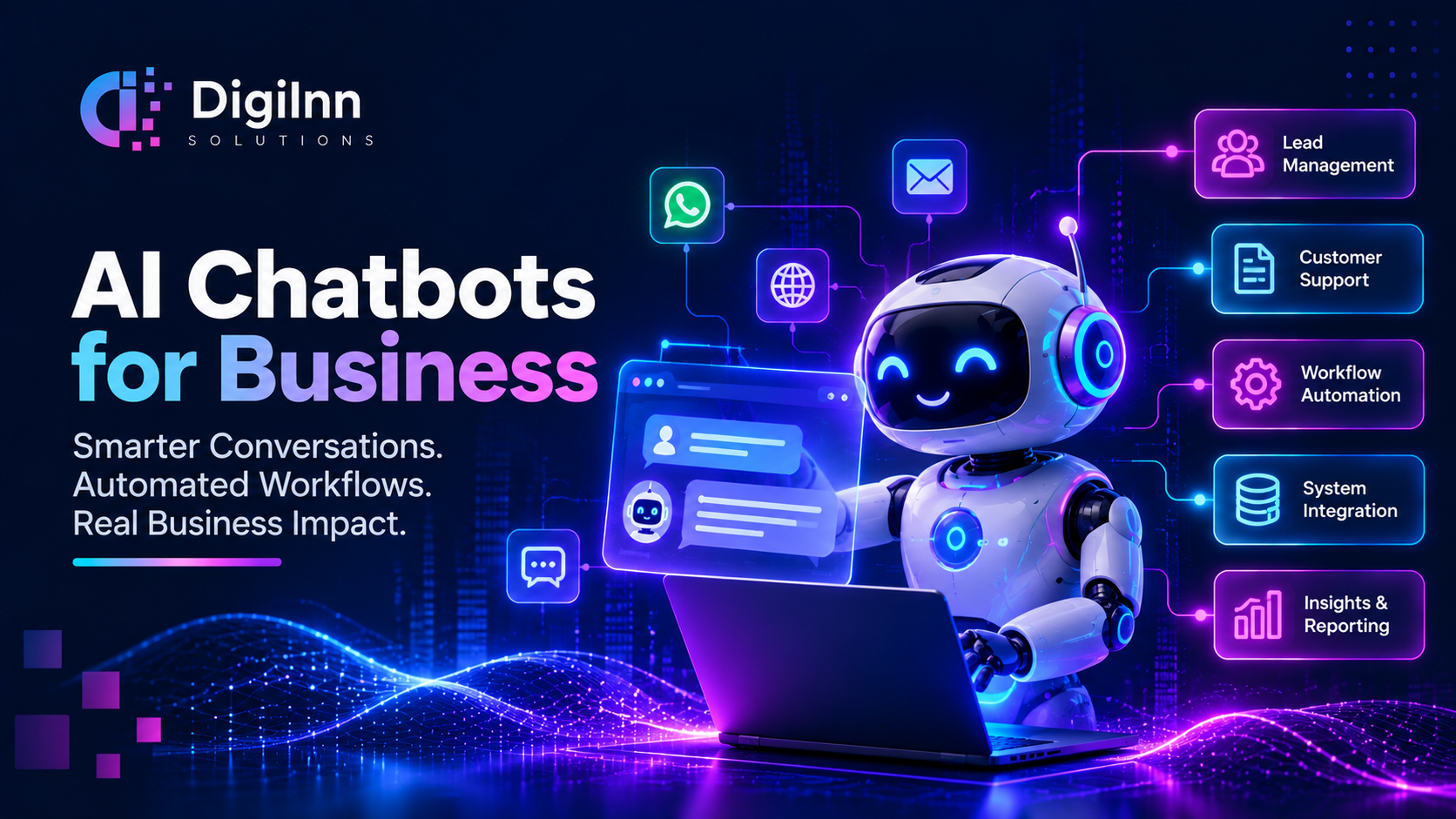
Identifying the customer's requirement
Collecting relevant inquiry details
Checking information in an authorized business system
Creating or updating a CRM record
Assigning the inquiry to the appropriate department
Preparing a follow-up response
Escalating unusual requests to a human employee
The difference is the ability to support a connected business process rather than simply produce a response.
However, not every chatbot is an autonomous AI agent. The capabilities depend on its design, integrations, permissions, and level of human oversight.
Why AI Workflow Automation Matters in 2026
Businesses have spent years investing in websites, CRM platforms, ERP software, accounting applications, and cloud-based tools.
Yet many organizations still face a common challenge.
Their systems do not communicate effectively.
Customer information remains in one application. Financial records exist in another. Employees manage follow-ups manually, while management depends on separate reports.
This creates unnecessary complexity.
AI workflow automation aims to reduce the gaps between business processes, systems, and teams.
For growing businesses, the opportunity is not simply to automate individual tasks.
It is to improve how information moves through the organization.
1. AI-Powered Lead Generation and CRM Automation
Lead management is one of the most practical applications of AI automation.
Businesses receive inquiries through websites, advertising campaigns, social media, and messaging platforms.
Without a structured process, leads may remain unanswered, be assigned inconsistently, or require repeated manual entry.
AI-powered lead management systems can be designed to support activities such as inquiry capture, initial qualification, CRM record creation, and follow-up coordination.
Example: A Connected Lead Management Workflow
Consider a potential customer visiting a software development company's website.
An AI assistant collects the visitor's business requirements and contact details.
The information is transferred to the company's CRM through an authorized integration.
The sales team receives a notification and can review the inquiry before contacting the customer.
Depending on the configuration, the system may also prepare follow-up messages or schedule approved reminders.
This creates a more structured customer journey while allowing employees to focus on meaningful sales conversations.
2. AI Customer Support Automation
Customer support teams often handle recurring questions about services, product availability, order status, and general business information.
AI-powered customer support systems can help answer routine inquiries using approved knowledge sources.
They may also classify support requests, create tickets, and route issues to relevant teams.
For example, a customer reporting a technical problem could interact with an AI assistant that gathers initial information and creates a support request.
A human technical specialist can then review the details and resolve the issue.
This approach can reduce repetitive information collection while maintaining human involvement where technical judgment is required.
Businesses considering AI customer support automation should prioritize accurate information, privacy, escalation procedures, and appropriate human oversight.
3. ERP and CRM Integration for Connected Operations
AI automation becomes more useful when business applications can exchange reliable information.
An organization may already use separate systems for:
Sales and customer relationships
Financial management
Inventory and procurement
Human resources
Project management
Reporting and analytics
When these systems operate independently, employees may need to move information manually between them.
ERP and CRM integration can help establish connected workflows across business functions.
For example, an approved sales transaction could trigger relevant updates in a connected order-management or finance system.
Inventory changes could be reflected in authorized operational dashboards.
Management could review consolidated information rather than requesting separate updates from each department.
AI may assist with information classification, exception detection, and workflow coordination, while deterministic software integrations handle transactions requiring accuracy and consistency.
The objective is to build a dependable digital ecosystem—not to introduce AI into processes where simpler automation would be more suitable.
4. AI Automation for Finance and Administration
Finance and administrative departments manage recurring activities that often involve significant documentation.
These may include invoice processing, expense categorization, payment reconciliation, approval routing, and reporting preparation.
AI-assisted workflows can help extract information from documents, classify records, identify inconsistencies, and prepare items for employee review.
For example, an invoice-processing workflow could:
Receive an invoice through an approved channel.
Extract relevant invoice details.
Compare information against available records.
Flag missing or inconsistent information.
Route the document for authorized approval.
Final financial decisions, payments, and compliance-sensitive activities should remain subject to appropriate controls.
For businesses managing growing transaction volumes, structured automation can help reduce repetitive administrative work.
5. AI Agents in Industry-Specific Business Operations
Different industries face different operational challenges.
A generic AI solution may not address those differences effectively.
This is why industry-specific automation is an important consideration.
Real Estate
Real estate businesses can explore automation for lead inquiries, property information requests, appointment coordination, and CRM updates.
These workflows can complement centralized real estate management systems.
Restaurants and Hospitality
Restaurants may use connected automation to support reservation inquiries, customer communication, order-status requests, and service-ticket coordination.
Healthcare and Diagnostics
Healthcare organizations may use carefully governed automation for non-clinical administrative tasks, appointment coordination, and general service inquiries.
Sensitive patient information and clinical decisions require additional safeguards and appropriate professional oversight.
Retail and E-Commerce
Retail businesses can use automation to support customer inquiries, product discovery, order communication, and internal workflow coordination.
Manufacturing
Manufacturing organizations can explore intelligent workflows for inventory alerts, documentation processing, procurement coordination, and operational reporting.
The most useful solution depends on the organization's systems, processes, and business objectives.
How to Implement AI Automation in Your Business
Successful AI adoption begins with identifying operational problems.
Before investing in AI agents or automation software, businesses should evaluate how their existing processes work.
Step 1: Identify Repetitive Operational Tasks
Review activities that require frequent manual effort.
These may include data entry, lead assignment, document classification, customer support, or internal reporting.
Step 2: Evaluate Existing Business Systems
Identify the applications currently used by different departments.
Determine whether those systems offer suitable APIs, integrations, and secure access controls.
Step 3: Select a High-Value Workflow
Start with a specific business problem rather than attempting to automate the entire organization.
A clearly defined workflow makes it easier to evaluate cost, implementation requirements, and business value.
Step 4: Establish Security and Human Oversight
Define what the AI system can access, which actions it can perform, and when employee approval is required.
Include appropriate safeguards for sensitive information and high-impact decisions.
Step 5: Test, Measure, and Improve
Evaluate performance using relevant operational indicators.
Depending on the workflow, these may include processing time, response quality, error rates, employee workload, or inquiry-handling efficiency.
Expand automation only when the initial implementation demonstrates sufficient reliability and business value.
Why Custom AI Automation Solutions Matter
Every business has different processes, customers, software systems, and operational requirements.
A ready-made automation tool may be suitable for common tasks.
However, organizations with complex workflows may require custom integrations or tailored software development.
Custom AI automation solutions can be designed around existing business processes rather than forcing organizations to adopt entirely new operating methods.
For example, a company may need an AI assistant connected to its website, CRM, internal database, and customer support system.
Another business may require automated reporting across multiple operational applications.
In these situations, custom software development and system integration become important parts of the solution.
The right approach depends on the complexity of the workflow, available infrastructure, security requirements, and expected business value.
How Digi-Inn Solutions Helps Businesses Build Smarter Operations
At Digi-Inn Solutions, we focus on developing technology solutions around real business requirements.
Our capabilities include custom software development, enterprise systems, application development, AI implementation, and business process automation.
We help organizations explore how connected digital systems can support their operational objectives.
Our approach begins with understanding the business process.
- Where does information originate?
- Which departments need access?
- What tasks are repetitive?
- Where do delays occur?
- Which activities require human approval?
Once these requirements are understood, an appropriate solution can be designed using software integration, workflow automation, AI capabilities, or a combination of technologies.
The objective is not to add more technology. It is to make existing business operations work better together.
The Future of AI in Business Is Connected, Practical, and Human-Centered
As AI technology develops, businesses will have more opportunities to automate selected processes and improve operational coordination.
However, successful adoption will depend on more than selecting the latest AI tool.
Organizations will need reliable information, connected systems, well-defined workflows, cybersecurity safeguards, and employees who understand how to work with the technology.
The most effective AI strategy is one that begins with a genuine business requirement and produces measurable operational value.
For growing companies, the next stage of digital transformation is not simply adopting AI.
It is identifying where AI can meaningfully improve the way the business operates.
Conclusion: Don't Just Adopt AI. Make It Work for Your Business.
AI agents and intelligent workflow automation are changing how organizations approach customer communication, lead management, administrative processes, and connected business operations.
But technology delivers value only when it solves a real problem.
Businesses that invest in reliable integrations, structured processes, and carefully selected automation opportunities can build a stronger foundation for long-term growth.
At Digi-Inn Solutions, we help businesses explore practical digital transformation through custom software, enterprise solutions, AI implementation, and workflow automation.
Your business doesn't need more disconnected tools. It needs smarter, connected operations.
Business Process Automation in 2026: How AI and Custom Software Are Transforming Business Operations
Oct. 27, 2026, 10:20 a.m.
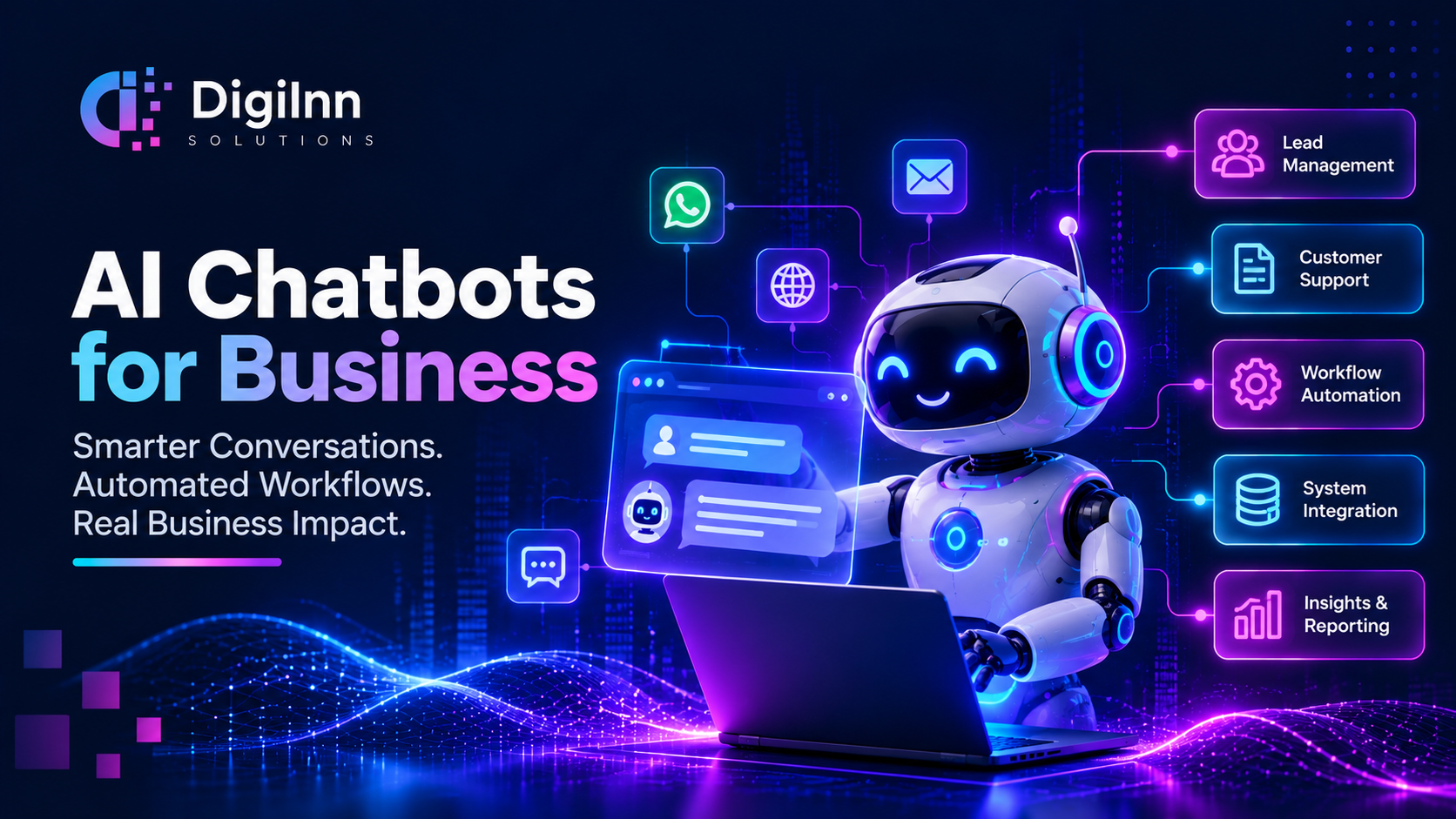
AI Agents for Business in 2026: How Intelligent Automation Is Transforming Business Operations
Oct. 19, 2026, 1:24 p.m.
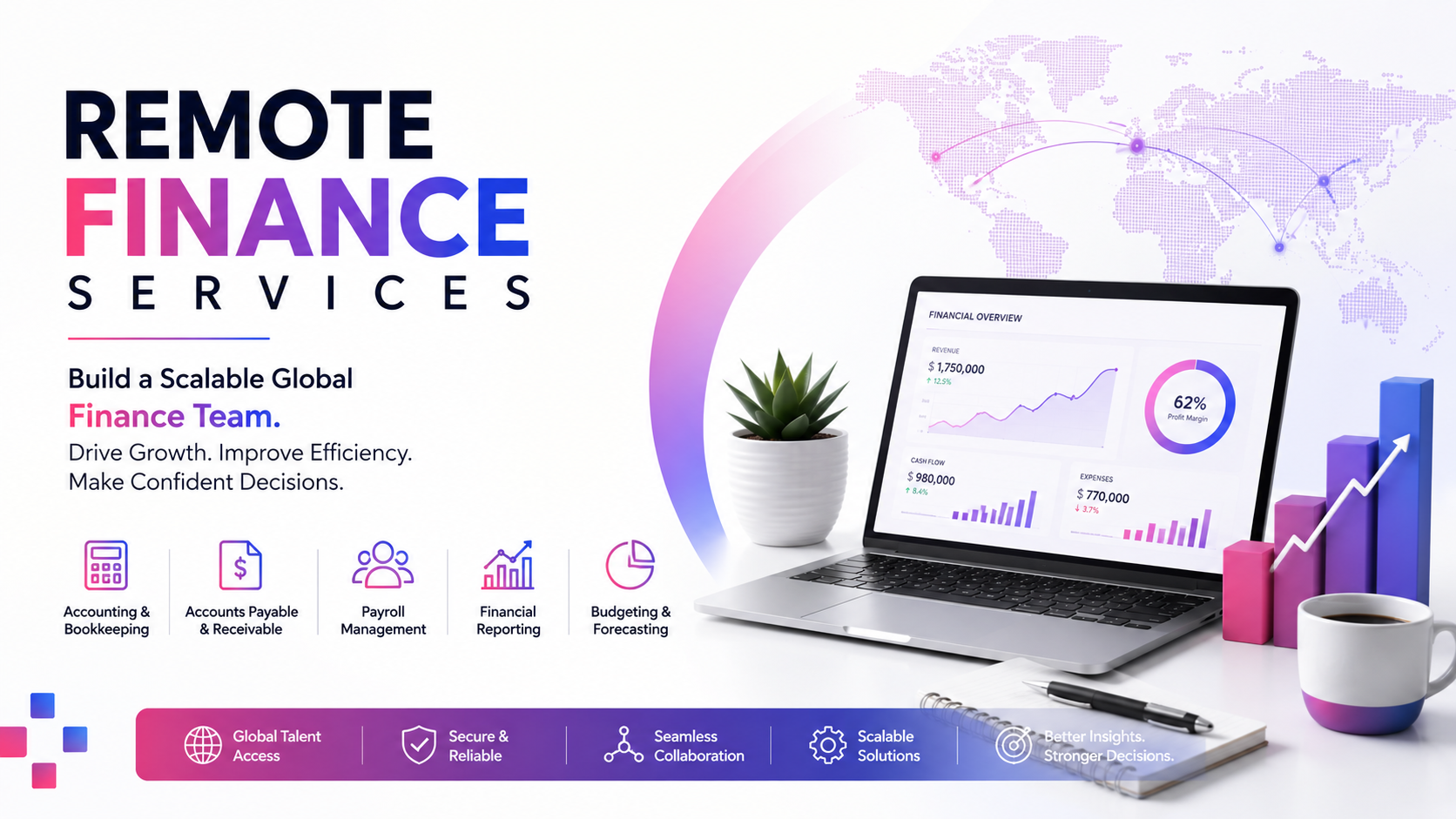
The Future of Business Operations: How Remote Services Help Companies Scale Globally
Oct. 12, 2026, 1:18 p.m.
Beyond Digital: How AI and Automation Are Redefining Business Transformation
Aug. 28, 2026, 2:16 p.m.

Leave A Comments