D
i
g
i
I
n
n

14Feb
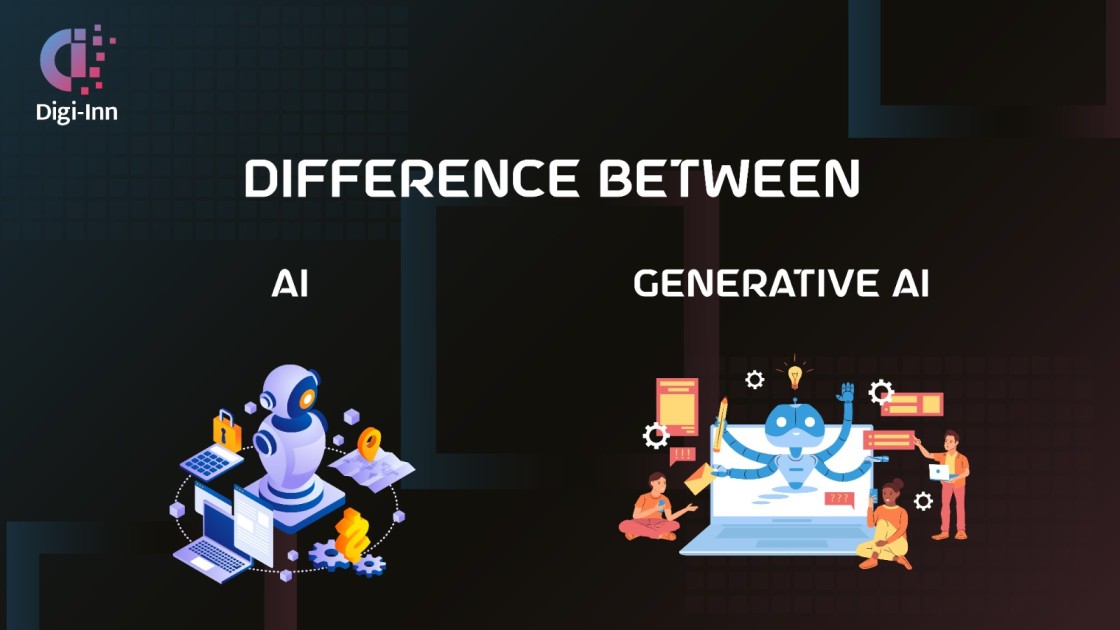
Difference between Ai and Generative Ai
As the world of technology is progressing, Artificial Intelligence has become a strong force of transformation in almost every industry. But the Ai has a strong and powerful part that is known as Generative Ai. The Generative Ai is changing the content creation, creativity and automation. There is a confusion among the people about what is the difference between Ai and Generative Ai. In this blog we will differentiate both of them on the basis of their fundamental architecture, application, training data and the way of learning, security concerns and computational requirements.
Fundamental Architecture: How Ai and Generative Ai Works? Traditional Ai
Usually traditional Ai is surrounded with several Machine Learning Models that are developed and designed to evaluate data, decision making and automate tasks. This usually involves
Rule-based Ai:- This Ai uses predefined rules and logic.
Machine Learning:- Machine Learning analyze previous data and makes predictions.
Deep Learning:- Deep Learning technology uses neural networks to identify patterns and improve decision-making skills.
Generative Ai
Generative Ai is a strong and powerful division of Artificial Intelligence. The Generative Ai is not only skillful in prediction or analyzing. It is specialized in generating new and creative content. Generative Ai combines with Deep Neural Networks, especially transformer models such as ChatGPT. Moreover Generative Ai combines with diffusion models to generate text, videos, images etc.
Key Difference
The key difference between Ai and Generative Ai is that Ai focuses on analyzing the data, making decisions and predictions. On the other hand, Generative Ai focuses on generating new, creative and original content after understanding the context and patterns from large datasets. Use Case Applications
Traditional Ai Applications
Recommendation System:- Netflix, Amazon and Spotify suggest personalized content.
Autonomous Vehicles:- Ai perception and decision making power self-driving cars.
Fraud Detection:- Banks use AI to sense doubtful transactions.
Chatbots and Virtual Assistants:- Siri, Alexa and Google Assistant provide user support.
Generative Ai Applications
Content Creation:- Ai generated tools such as ChatGPT, DeepSeek to generate text. Other tools to generate images and videos.
Coding Assistance:- GitHub or Copilot helps the developers to write effective and organized code.
Music and Video Generation:- These Generative Ai tools produce original framework and Deepfake videos.
Medications:- Generative Ai accelerates molecular design for new medicines.
Key Differences
Traditional Ai is task-orientated and improves efficiency. On the other hand Generative Ai generates original, human-like content with very less human interference. Training Data Learning Methods
Traditional Ai Learning
Supervised Learning: AI is trained on labeled datasets (e.g., spam detection).
Unsupervised Learning: AI identifies hidden patterns without labeled data (e.g., customer segmentation).
Reinforcement Learning: AI learns through trial and error (e.g., robotics and game-playing AI like AlphaGo).
Generative AI Learning Methods
Transformer Models: Leverages self-attention mechanisms to process and generate sequential data efficiently.
GANs (Generative Adversarial Networks): Uses two competing neural networks to generate highly realistic content.
Diffusion Models: Create high-quality images and videos by reversing noise-based transformations.
Key Difference
Traditional AI learns to recognize and classify patterns, whereas Generative AI learns to generate new content by understanding and mimicking complex data patterns. Ethical and Security Concerns
Ethical Challenges in AI
Bias and Fairness: AI can reinforce biases present in training data, leading to discriminatory decisions.
Privacy Issues: AI systems collecting user data may pose security risks.
Job Displacement: Automation in AI can replace human jobs, raising employment concerns.
Ethical Concerns in Generative AI
Deepfakes and Misinformation: AI-generated fake videos and images can spread false information.
Intellectual Property Issues: AI-generated content raises questions about copyright ownership.
Misinformation Amplification: Generative AI models might produce incorrect or misleading content.
Key Difference
While both AI and Generative AI raise ethical concerns, Generative AI poses greater risks in terms of misinformation, deep fakes, and copyright issues due to its ability to generate human-like content.
Computational Requirement: Performance and Efficiency
Traditional AI Computational Needs:
Requires moderate processing power for data analysis, pattern recognition, and decision-making.
Can run on CPU-based systems for many applications.
Works efficiently on small to mid-sized datasets.
Generative AI Computational Needs
Requires high-performance GPUs and TPUs due to deep neural network complexity.
Needs massive datasets and continuous model fine-tuning.
Demands cloud-based infrastructure to train and deploy large-scale models like ChatGPT and Stable Diffusion.
Key Difference
Traditional AI can run on moderate computing resources, while Generative AI demands extensive computational power and memory, making it more resource-intensive.
Conclusion
Both Traditional AI and Generative AI have distinct strengths and cater to different use cases. If your goal is data-driven decision-making and automation, Traditional AI is the right choice. However, if you need content creation and creativity-driven applications, Generative AI offers unmatched potential.
Other articles you may find interesting



Leave A Comments