
21Sep
AI Chatbot vs AI Task Assistant: The Next Step in Business Automation
Artificial Intelligence is changing the way businesses communicate, operate, and make decisions.
For years, businesses viewed chatbots primarily as tools for answering frequently asked questions. A customer would type a question, the chatbot would provide an answer, and the conversation would end.
But business technology is moving beyond simple conversations.
The next generation of AI chatbot development is creating intelligent assistants that can understand business knowledge, access information, perform tasks, automate workflows, generate reports, and support employees across different operations.
This is the shift from an AI chatbot to an AI Chat and Tasks Assistant.
And it represents an important next step in business automation.
What Is an AI Chat and Tasks Assistant?
An AI Chat and Tasks Assistant is more than a conversational chatbot.
It combines conversational AI with business systems, knowledge bases, data, automation, and task management.
Instead of simply answering:
What is our company policy?
an intelligent assistant can potentially answer the question from the organization's knowledge base and then help perform the next action.
For example:
- Find information from internal documents
- Generate a report
- Retrieve customer information
- Start an automated workflow
- Track a user request
- Summarize business data
- Assist employees with internal processes
- Connect with existing software and databases
This creates a more connected form of AI business automation.
Why Traditional Chatbots Are No Longer Enough
Traditional chatbots are useful for basic customer interactions.
They can answer FAQs, provide predefined information, and guide users toward specific pages or services.
However, modern businesses often require much more.
Business information is spread across:
- Documents
- Databases
- CRM systems
- ERP platforms
- Internal knowledge bases
- Reports
- Emails
- Customer records
- Operational systems
If an AI assistant cannot access relevant business knowledge or interact with business workflows, its usefulness can remain limited.
This is why organizations are increasingly exploring custom AI chatbot development and intelligent automation rather than relying only on basic scripted bots.
The Core Features of an Intelligent AI Assistant
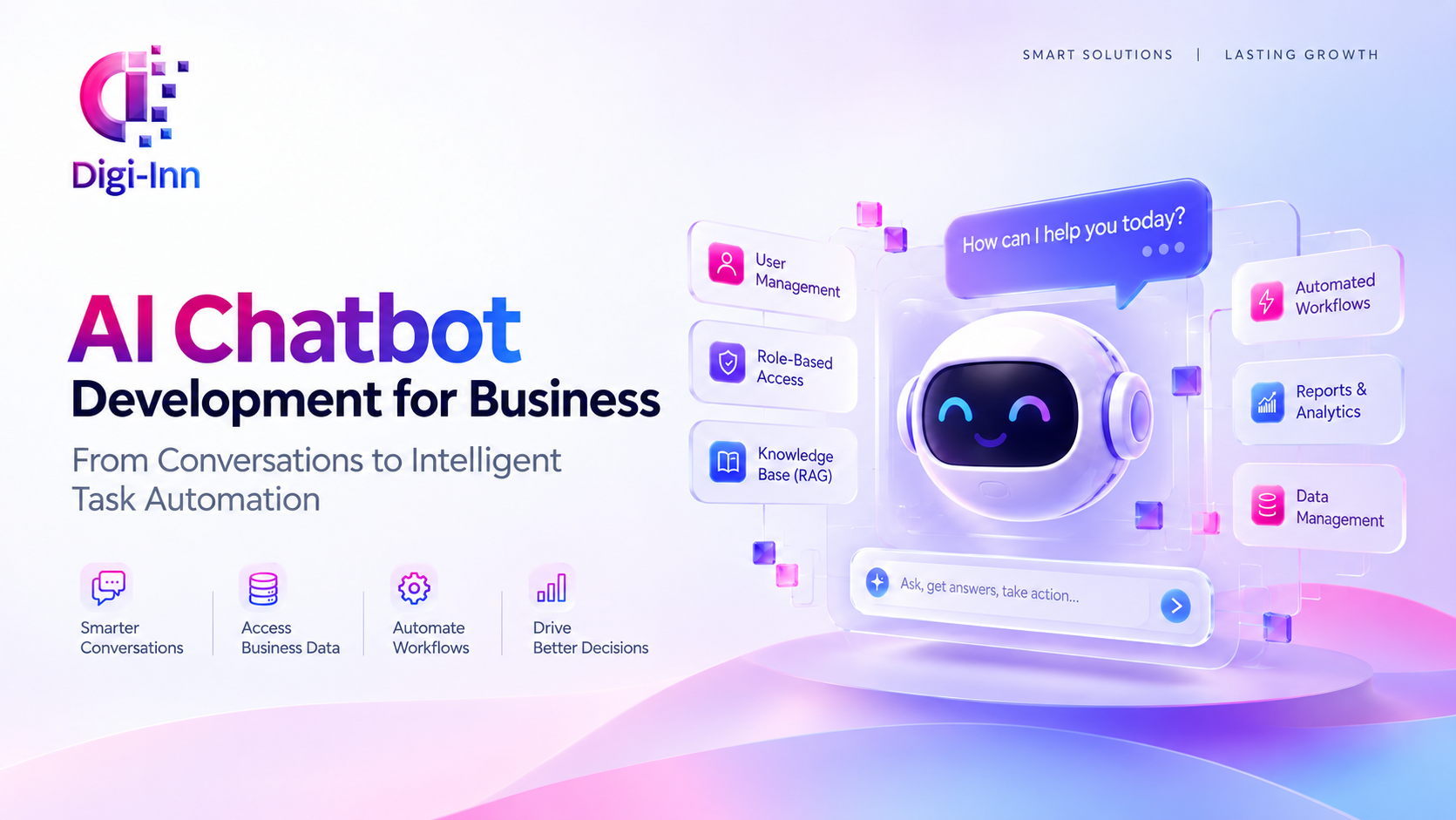
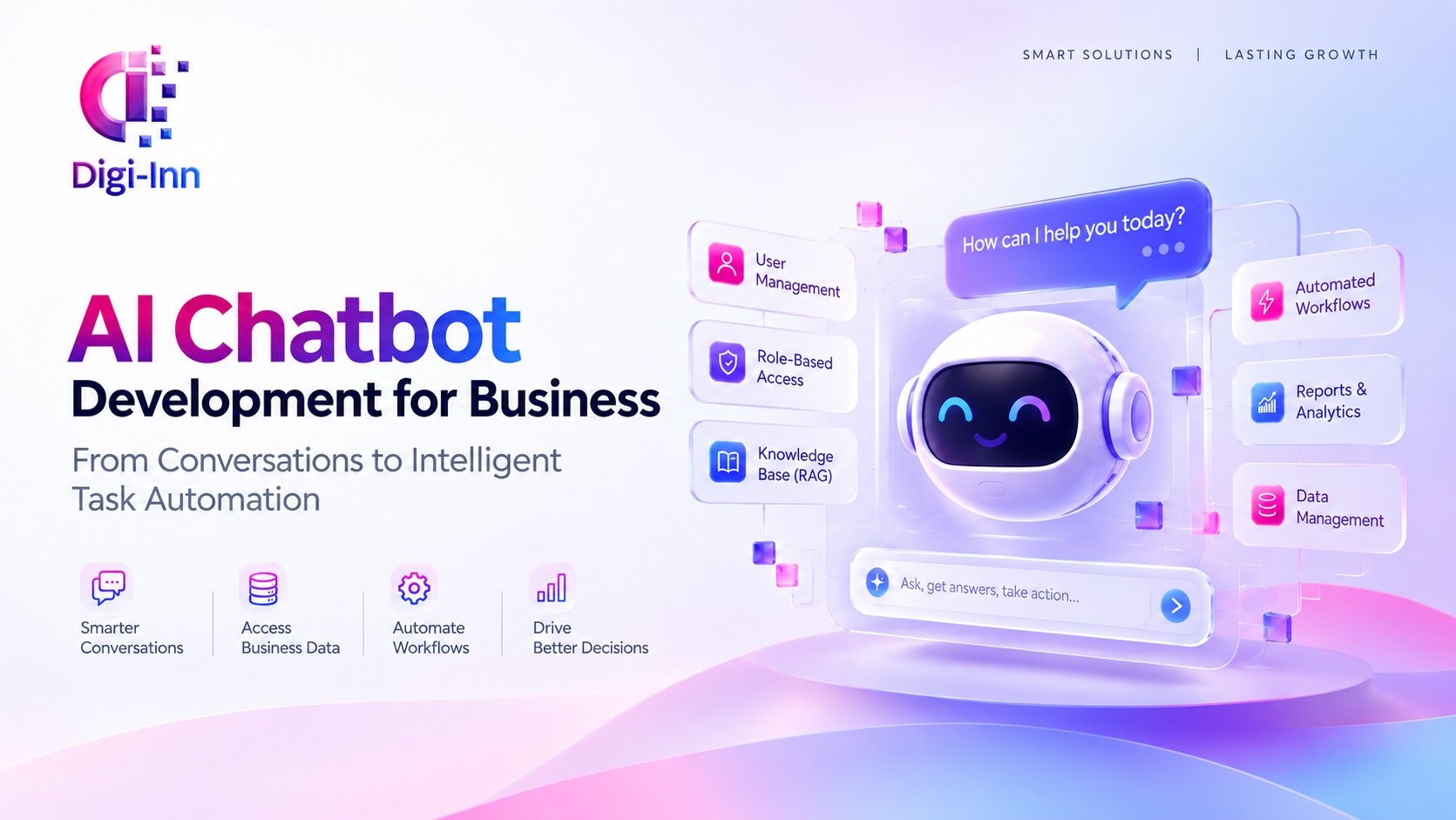
The AI Chat and Tasks Assistant shown by Digi-Inn Solutions brings together several capabilities designed for more advanced business use.
1. User Management
Different users may require different information and capabilities.
User management allows organizations to control who can access the AI assistant and how it can be used.
This becomes particularly important for businesses with multiple departments, teams, customers, or administrative levels.
2. Role-Based Access
Not every employee should have access to every piece of business information.
Role-based access can help establish different permissions for administrators, managers, employees, customers, or other users.
This makes an enterprise AI assistant more practical for organizations where information security and access control matter.
3. Personal Knowledge Base
One of the biggest advantages of an intelligent AI assistant is its ability to work with business-specific information.
A personal AI knowledge base can organize relevant documents, information, policies, procedures, and other resources so users can interact with company knowledge through natural language.
Instead of manually searching through multiple files, employees can ask questions and retrieve relevant information through a conversational interface.
4. Fine-Tuning and RAG
Generic AI models do not automatically know the latest or most specific information about your organization.
This is where technologies such as Retrieval-Augmented Generation (RAG) become valuable.
A RAG chatbot can retrieve relevant information from a connected knowledge source before generating a response.
This approach allows businesses to create AI assistants that are grounded in their own information rather than relying only on general-purpose model knowledge.
5. Automated Workflows
The real transformation begins when AI moves beyond answering questions and starts supporting processes.
AI workflow automation can connect conversations with business actions.
For example, an assistant could potentially receive a request, identify the required information, trigger a workflow, and route the task to the appropriate person or system.
This creates a bridge between conversational AI and business process automation.
6. Chat Mode
Natural-language interaction remains at the center of the experience.
Employees and customers can communicate with the assistant in a conversational way instead of learning complicated software interfaces.
This can make complex information easier to access.
7. Cache
Caching can help improve the efficiency of frequently requested information and reduce unnecessary processing.
For businesses handling repeated queries, efficient information retrieval can contribute to a faster user experience.
8. Reports and Data Management
An intelligent assistant can also become a layer between users and business data.
Instead of manually navigating multiple dashboards, users can ask for information in natural language and receive relevant reports or summaries.
This creates opportunities for more accessible AI-powered business intelligence and data management.
9. User Tracking and Logging
Enterprise AI requires visibility.
User tracking and logging can help organizations understand how the system is being used, monitor interactions, and maintain operational records.
These capabilities become particularly important as AI becomes integrated into everyday business processes.
From AI Chatbot to Intelligent Business Infrastructure
The biggest shift is not the chatbot itself.
It is what happens behind the chatbot.
A modern AI assistant can sit between employees, customers, company knowledge, databases, software systems, and automated workflows.
That makes AI part of the organization's digital infrastructure.
This direction closely follows Digi-Inn Solutions' broader approach to digital transformation: connecting technology with business processes rather than treating software as an isolated tool. Digi-Inn already provides custom software solutions covering ERP, CRM, inventory/POS, HRM, and mobile applications, while its digital services include lead generation, keyword targeting, advertising, and SEO.
The next step is making those systems more intelligent.
What Businesses Should Consider Before Implementing AI
Start AI implementation with a business problem, not simply the desire to “use AI.”
Businesses should identify:
What information do employees repeatedly search for?
Which customer questions consume the most support time?
Which workflows involve repetitive manual steps?
Where is business data currently fragmented?
Which tasks could be automated without removing necessary human oversight?
Once these questions are answered, the organization can determine where an AI virtual assistant, RAG chatbot, workflow automation system, or custom AI solution can create practical value.
The Next Step in Digital Transformation
The evolution is becoming clear:
Website → Smart Website → AI Chatbot → AI Assistant → AI-Powered Business Workflow
A chatbot answers.
An AI assistant understands.
An intelligent business system can help execute.
That is where the future of AI automation and custom software development is heading.
Businesses don't simply need another chatbot window on their website.
They need technology that understands their information, connects with their systems, supports their teams, and helps move work forward.
At Digi-Inn Solutions, this next generation of technology can become part of a broader digital ecosystem combining custom software, AI integration, automation, websites, CRM/ERP solutions, digital marketing, and SEO.
The future of AI isn't just about having a conversation.
It's about turning that conversation into action.
Digital Transformation in 2026: How Businesses Can Turn Technology Into a Competitive Advantage
Sept. 4, 2026, 12:07 p.m.
Beyond Digital: How AI and Automation Are Redefining Business Transformation
Aug. 28, 2026, 2:16 p.m.
Restaurant Inventory Management: How to Reduce Food Waste, Stock Loss & Improve Profitability
Aug. 20, 2026, 10:48 a.m.

Leave A Comments